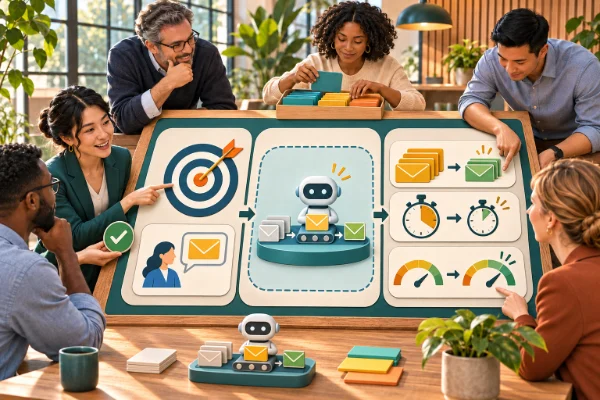
AI vs Traditional Automation at Work

Let us have a candid conversation about taking your time back. Not too long ago, I found myself sitting at my desk on a Friday afternoon, staring at a mountain of repetitive administrative work. I felt completely drained before the creative, strategic part of my business had even been touched. As women navigating the fast-paced world of modern entrepreneurship and career growth, we wear countless hats. We are strategists, creators, managers, and visionaries. But far too often, we get bogged down in the endless loop of data entry, email triage, and scheduling. This is exactly where the strategic use of technology becomes our greatest ally.Today, I want to guide you through a topic that has fundamentally transformed how I run my day-to-day operations: understanding the nuances of generative AI vs traditional automation. While these terms are often thrown around interchangeably in tech circles, they serve entirely different purposes. Knowing how to leverage each one is the secret to building a business that works for you, rather than the other way around.The Reliable Rule-Follower: Traditional AutomationThink of traditional automation as your incredibly reliable, highly organized virtual assistant who follows instructions to the letter, but never deviates from the script. This technology is built on a straightforward premise: "If this happens, then do that." It relies on fixed rules, structured data, and predictable outcomes.I remember setting up my very first automated workflow years ago. I used a tool to automatically save email attachments directly to a specific cloud folder. It sounds so simple now, but it felt like magic. I no longer had to manually download and drag files. Traditional automation excels at moving data from point A to point B without human intervention. Tools like Zapier, Make, and built-in email filters fall into this category.You should lean on traditional automation when dealing with repetitive administrative work that does not require subjective judgment. For example, automatically generating a standard invoice when a client signs a contract, syncing your calendar appointments to your task manager, or sending a pre-written welcome sequence when someone subscribes to your newsletter. It thrives on predictability. If the input is always exactly the same, traditional automation will flawlessly execute the task a thousand times over without breaking a sweat.The Creative Thought Partner: Generative AINow, let us introduce the newer, more dynamic player in our productivity toolkit: generative AI. If traditional automation is the assistant moving files around, generative AI is your creative collaborator sitting across the desk, ready to brainstorm, draft, and analyze. Powered by large language models, this technology does not just move existing data; it creates net-new content based on the context you provide.My relationship with my workload shifted dramatically when I began treating AI as a mentor and sounding board rather than just a search engine. Generative AI thrives in ambiguity. It can draft a nuanced email to a frustrated client, summarize a chaotic one-hour meeting transcript into actionable bullet points, or suggest five different marketing angles for your next product launch. It understands context, tone, and intent.When comparing generative AI vs traditional automation, the defining factor is adaptability. Generative AI can read an incoming email, understand that the sender is asking for a refund because a product arrived damaged, and draft an empathetic, policy-compliant response for your review. Traditional automation could never do this because it cannot interpret the meaning behind the text; it only recognizes rigid triggers.Mapping Your Business TasksTo truly reclaim your schedule, you need to audit your current business tasks and delegate them to the right technological counterpart. I want you to look at your weekly calendar and highlight the tasks that drain your energy. Then, categorize them.Use traditional automation for your rigid processes. When you need data to flow seamlessly between software platforms without errors, rely on rule-based triggers. This includes accounting transfers, lead routing, CRM updates, and scheduling links. The goal here is strict consistency and operational stability.Use generative AI for your flexible, creative bottlenecks. When you find yourself staring at a blank page or feeling overwhelmed by a massive document, bring in AI. Let it write your initial drafts, create outlines for your presentations, translate complex industry jargon into simple client-facing language, or help you brainstorm solutions to a strategic hurdle. Remember, AI drafts the baseline, but your unique voice and expertise provide the final polish. Never abdicate your editorial control.Building the Ultimate Hybrid WorkflowThe true magic happens when you stop viewing these tools as mutually exclusive and start combining them. This is where you can build systems that feel almost indistinguishable from having a full team supporting you.Let me share a hybrid workflow I built recently that saved me hours every week. I set up a traditional automation trigger on my website contact form. Whenever a prospective client fills out the form, traditional automation catches that data. Instead of just notifying me, it sends the data to a generative AI tool with a specific prompt: "Analyze this client's industry and goals, and draft a customized introductory email highlighting how my services can help them." Finally, traditional automation takes that newly generated draft and places it safely in my email drafts folder.By the time I open my inbox, the repetitive data transfer is done, and the creative heavy lifting of a first draft is waiting for my review. I simply add a personal greeting, tweak a few sentences to perfectly match my tone, and hit send. This hybrid approach ensures you remain the strategic decision-maker while technology handles both the manual labor and the initial creative friction.Stepping Forward with ConfidenceI know that adopting new technology can feel overwhelming, especially when you are already stretched thin. The secret to integrating AI tools for business is to start incredibly small. Do not attempt to automate your entire business operation in one weekend. Choose just one recurring frustration.Perhaps next week, you set up one rule-based automation to sort your incoming invoices. The following week, you might ask an AI to help you draft a standard operating procedure for your home office. Build your digital infrastructure brick by brick. You will quickly find that the time you invest in setting up these systems pays dividends, giving you the breathing room to focus on what you truly love.Technology should empower your vision, not complicate your day. By understanding the distinct roles of generative AI and traditional automation, you can curate a personalized ecosystem of tools that support your growth, protect your energy, and allow your unique talents to shine. You have the capability to design a highly organized, efficient business. Take it one task at a time, and watch how much space opens up in your life.